
Waterfall Countertop Edge Detail and Other Kitchen Trade-Offs You'll Have to Choose
The small kitchen decisions that end up shaping your whole renovation
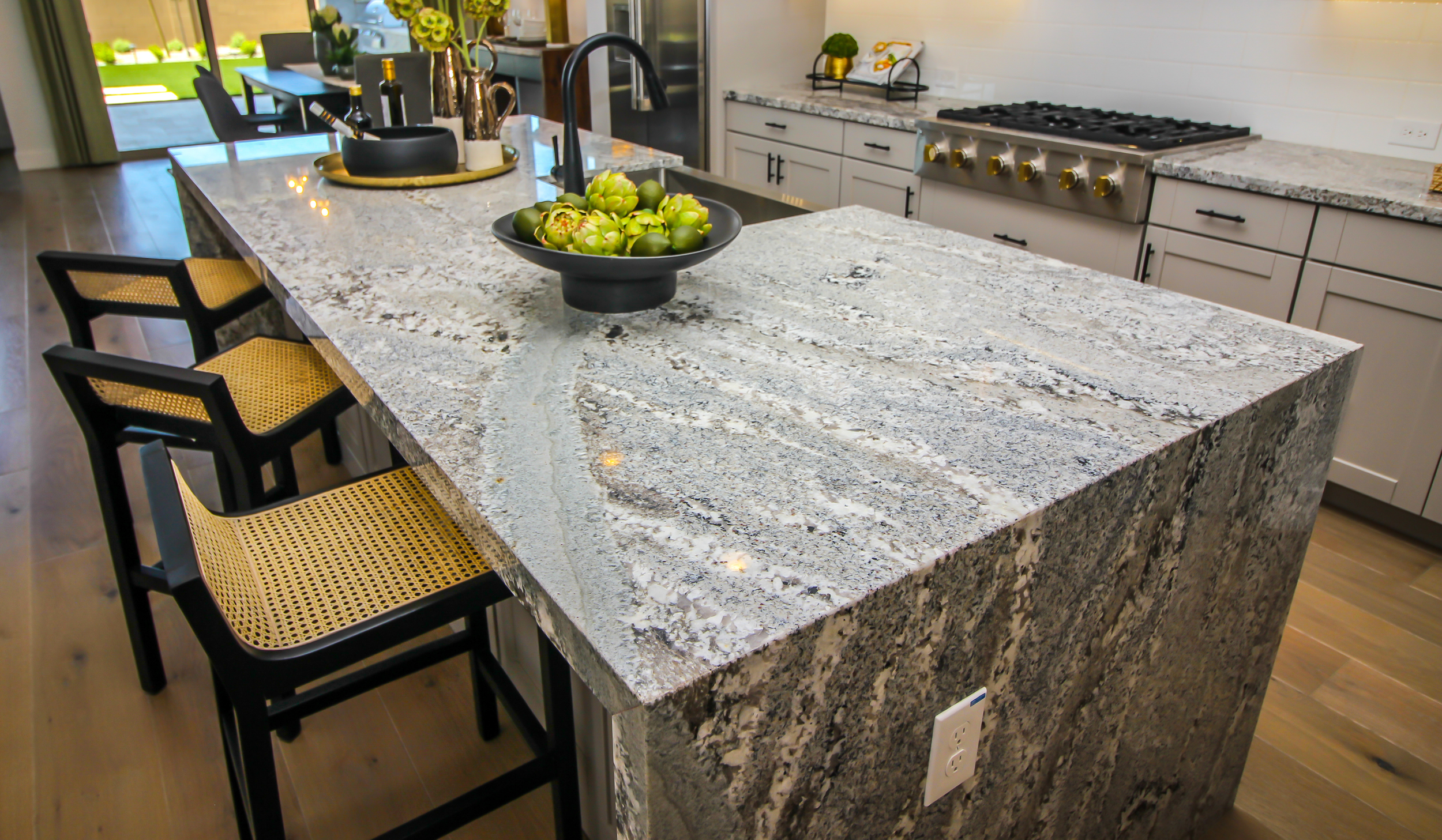
A waterfall countertop edge detail seems like a small decision. It's just a slab of stone that wraps down the side of your island instead of stopping at a normal edge. But it's actually one of the clearest examples of something you'll run into again and again in a kitchen renovation: form versus function.
Do you choose the version that makes people stop mid-sentence when they walk in, or the one that's more practical, more affordable, or actually backed by a warranty?
I ran into this exact fork in the road with a client recently, except her version wasn't about countertops. It was about her glass cabinets. Here are some of the most common kitchen decisions like hers, plus a few renovating tips for how to think through each one.
Cabinet Supports Come First, Whether You Like It or Not
She had a gorgeous glass cabinet with a mid rail (that horizontal bar running across the middle of the door) and wanted it gone for a cleaner look. Here's the catch. That mid rail is a cabinet support, and it's what keeps a tall, five-piece shaker door from warping or sagging over time. Skip it, and the cabinet loses its warranty. Period.
So her real choice came down to this: keep the cabinet supports and stay covered, or lose them for a sleeker look and take on all the risk herself.
Here's the thing about that decision. It's barely about glass cabinets at all. It's the same trade-off hiding inside almost every choice you'll make in a kitchen renovation, just wearing a different outfit each time.
Waterfall Countertop Edge Detail: Drama vs. Durability
A waterfall countertop edge detail is the countertop version of that cabinet decision, minus the warranty conversation and plus a bigger price tag.
On the form side, there's nothing more dramatic in a kitchen. It reads custom, expensive, and intentional in a way a standard edge just doesn't. It's the detail people photograph the second they walk in.
On the function side, you're paying for that drama. A waterfall edge needs a larger slab with veining that matches perfectly across both faces, which rules out a lot of budget-friendly stone right off the bat. It's trickier to fabricate, and it's more painful (and pricier) to repair if that edge ever chips, which it will, probably from someone shoving a barstool back a little too hard.
A standard edge costs less, holds up better to daily life, and is easier to fix if something does go sideways. It just doesn't turn heads the same way.
Neither option is wrong. It just depends on whether you want the showstopper or the easier upkeep. (If the drama is calling your name, check out a few of my favorite marble slabs before you commit to a stone.)
Panel Ready Appliances: The Disappearing Act With a Real Price Tag
Panel ready appliances are having a moment right now, and I get why. Instead of a stainless fridge staring back at you every time you walk into the kitchen, you get a custom cabinet panel that makes your refrigerator and dishwasher vanish right into the cabinetry.
Here's the trade-off nobody mentions in the Pinterest caption. Panel ready appliances cost significantly more than their standard counterparts, and they limit which brands and models you can even choose from. Your cabinet design also has to be locked in earlier and more precisely, since the panel is built to fit that exact appliance, not a general size range.
Standard appliances are more affordable and give you way more flexibility to shop around, but they'll never blend into your cabinetry the same way. This is one of those purely aesthetic calls with a very real cost attached, worth deciding early since it shapes your entire cabinet layout.
Single Bowl vs Double Bowl Kitchen Sink: Sleek vs. Practical
The single bowl vs double bowl kitchen sink debate is less about which one is objectively better and more about how you actually use your sink on a random Tuesday.
A single bowl gives you one big, uninterrupted basin. It looks sleek and modern, and it's the only real option if you're regularly washing sheet pans or the roasting pan that only comes out for Thanksgiving.
A double bowl splits the sink into two sections, which makes it easier to separate tasks. Soak dishes on one side while you rinse produce on the other, or keep the disposal side away from the side you actually wash things in.
If you cook constantly and need to multitask at the sink, a double bowl usually wins on practicality. If you want the cleanest possible look and don't mind adjusting how you manage dishes, single bowl tends to win. (And if you're also torn between a farmhouse and apron front style, this breakdown walks through how they actually differ.)
How to Actually Decide on Your Waterfall Countertop Edge Detail (and Everything Else)
A waterfall countertop edge detail, panel ready appliances, the sink debate… it doesn't matter which one you're up against. The process for deciding is basically the same.
Start with what actually matters to you, not what's trending this year. Then ask what you're giving up with each option. Is it warranty coverage on your cabinet supports? Budget, if you go with the waterfall edge? Flexibility, if you commit to panel ready appliances? Daily convenience, if you pick a single bowl sink because it looks better in photos?
There's no universal right answer here. There's only the right answer for how you actually cook, clean, and live in your kitchen.
The Real Question Behind Every Waterfall Countertop Edge Detail Decision
Kitchen design is full of these moments, decisions that force you to pick between how something looks, how it functions, or what it's actually backed by. The glass cabinet mid rail is just one example. A waterfall countertop edge detail, panel ready appliances, even your sink configuration… they all carry the same kind of trade-off underneath the surface.
The goal isn't to avoid the decision. It's to understand exactly what you're trading before you make it.
✔️Ask the questions,
✔️ Weigh what actually matters to you,
✔️and choose with your eyes open.
That's the difference between a kitchen you love and one you're quietly annoyed with for the next fifteen years.
Your Next FREE Step
Download my reno guide, Before You Renovate: What Every Homeowner Should Know, before you lock in a single finish.
It walks you through…
Why layout always has to come before finishes,
What actually falls under "cabinetry" (and why two quotes for the same kitchen can look wildly different),
And how to design a kitchen for the way you actually live instead of the way it photographs.
Grab the FREE guide here→ Before You Renovate: Every Homeowner Should Know the Top 7 Mistakes to Avoid

About Taylor Ferrell: Your Central Coast Kitchen Renovation Partner
Taylor Ferrell is the cabinetry-obsessed founder of SALT Design Co. She helps homeowners on California's Central Coast (and virtually, everywhere else) work through decisions like these one detail at a time, no design degree required on your end. If you're mid-renovation and stuck on a call like this one, she’d love to help you sort it out. Book a 30-minute Zoom with Taylor anytime.